The Five Solas—Sola Scriptura, Sola Fide, Sola Gratia, Solus Christus, and Sola Deo Gloria—were theological rallying cries during the Protestant Reformation, readily available in PDF format.
These principles challenged medieval Catholic doctrine, emphasizing scripture as the ultimate authority and salvation through faith alone, often explored in detailed PDF studies.
Understanding these tenets, frequently found in accessible PDF resources, is crucial for grasping the Reformation’s impact and its enduring legacy on Christian thought.
Historical Context of the Reformation
The Reformation, erupting in the 16th century, wasn’t a spontaneous event but the culmination of centuries of growing discontent within the Catholic Church. Issues like perceived corruption, the sale of indulgences, and theological disagreements fueled widespread calls for reform, readily documented in historical PDFs.
The Renaissance fostered humanism, encouraging a return to original sources, including scripture, prompting critical examination of established doctrines. The invention of the printing press facilitated the rapid dissemination of new ideas, including those central to the Five Solas, often found in digitized PDF collections.
Martin Luther’s 95 Theses, sparking the movement, directly addressed these concerns, laying the groundwork for the theological principles encapsulated in the Solas, now widely accessible through online PDF archives.
The Five Solas: A Brief Overview
The Five Solas represent core tenets of the Protestant Reformation, succinctly summarizing its theological stance. Sola Scriptura (“Scripture alone”) asserts the Bible as the supreme authority, often detailed in introductory PDF guides. Sola Fide (“faith alone”) emphasizes justification through faith in Christ, explored in numerous theological PDFs.
Sola Gratia (“grace alone”) highlights salvation as God’s unearned favor, while Solus Christus (“Christ alone”) affirms Jesus as the sole mediator, both readily available in PDF format. Finally, Sola Deo Gloria (“glory to God alone”) emphasizes that all glory belongs to God.
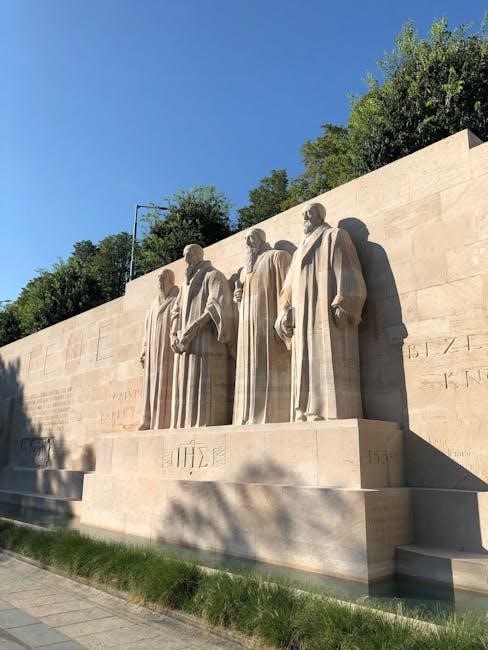
Sola Scriptura – Scripture Alone
Sola Scriptura affirms the Bible’s ultimate authority, rejecting tradition as equal to scripture; detailed explanations are available in comprehensive PDF resources.
The Catholic Church’s View on Scripture and Tradition
The Catholic Church doesn’t reject Scripture, but views it within the broader context of Sacred Tradition and the Magisterium—the teaching authority of the Church.
This perspective, often detailed in PDF theological analyses, asserts that Tradition isn’t separate from Scripture, but rather its living transmission, guided by the Holy Spirit.
The canon of Scripture itself was defined by the Church, as evidenced by figures like Augustine, whose work predates the Council of Trent, readily available in PDF format.
Catholics believe both Tradition and Scripture are necessary for understanding divine revelation, offering a unified source of faith, explored in numerous PDF documents.
The Formation of the Biblical Canon
The Biblical canon didn’t “fall” from heaven fully formed; it was a process of discernment by the early Church, a history often detailed in PDF scholarly works.
Early Christians debated which texts were authentically apostolic and inspired, relying on Tradition to guide their decisions, a process documented in accessible PDF resources.
Augustine’s writings in the early 5th century reflect a canon largely aligning with the one affirmed at the Council of Trent, available in PDF historical texts.
This demonstrates the Church’s role in recognizing and preserving the authoritative Scriptures, a topic extensively covered in PDF theological studies.
Challenges to Sola Scriptura: Interpretation and Authority
Sola Scriptura faces inherent challenges regarding interpretation; differing denominations demonstrate varied understandings of the same texts, often explored in comparative PDF analyses.
Without a definitive interpretive authority, disagreements on dogma arise—like baptism’s necessity for salvation—highlighting the need for a “referee,” as discussed in PDF theological debates.
Even within Catholicism, nuanced interpretations exist, yet the Magisterium provides authoritative guidance, a concept detailed in PDF Catholic responses to the Solas.
These complexities underscore the practical difficulties of relying solely on individual interpretation, a point frequently raised in critical PDF reviews.
Early Church Fathers and the Canon
The formation of the biblical canon wasn’t a sudden event; it evolved through recognition by the early Church, a process detailed in historical PDF documents.
St. Augustine’s list in On Christian Doctrine (early 400s), available in PDF translations, remarkably aligns with the Council of Trent’s later declaration, demonstrating early consensus.
Early Lutherans, pioneers in patristic study—especially Chemnitz—recognized this historical continuity, as evidenced in their PDF commentaries.
This demonstrates the canon wasn’t arbitrarily decided but organically affirmed by those closest to the apostolic age, a point explored in scholarly PDF articles.

Sola Fide – Faith Alone
Sola Fide, justification by faith alone, was central to the Reformation, challenging works-based salvation; detailed explanations are available in numerous PDF resources.
Luther’s Understanding of Justification by Faith
Martin Luther vehemently argued that humans are justified—declared righteous—by God’s grace alone, through faith in Jesus Christ, not by any merit of their own works. This concept, foundational to Sola Fide, directly opposed the prevailing Catholic view of salvation requiring both faith and good works.
Luther’s insights, deeply rooted in his study of Scripture, particularly Paul’s letters in Romans and Galatians, emphasized that faith is not merely intellectual assent but a trusting reliance on Christ’s atoning sacrifice. Extensive analyses of Luther’s theology, including his writings on justification, are readily accessible in PDF format for further study.
He believed that attempting to earn salvation through works obscured the true gift of God’s grace.
The Catholic Perspective on Faith and Works
The Catholic Church maintains that justification is a process involving both faith and works, synergistically cooperating with God’s grace. Faith is the initial acceptance of God’s offer of salvation, but it must be demonstrated and strengthened through good works performed in love.
This perspective rejects the Protestant notion of “faith alone,” arguing that genuine faith naturally produces good works as evidence of its authenticity. Detailed explanations of this doctrine, often contrasting it with Sola Fide, are available in PDF documents outlining Catholic theology.
Works are not seen as earning salvation, but as a necessary response to God’s grace.
Nuances within the Sola Fide Doctrine
While Sola Fide emphasizes justification by faith alone, it doesn’t imply that good works are irrelevant. Early Lutherans, steeped in Church history, understood faith as a living, active force that inevitably produces good works as its fruit—not as a means to earn salvation.
This nuanced understanding avoids antinomianism, the belief that Christians are freed from moral law. Comprehensive analyses of these subtleties, often found in scholarly PDFs, reveal the complexities within the Reformation’s core tenets.
Faith is the root, good works the evidence.
The Role of Good Works in Reformed Theology
Reformed theology doesn’t dismiss good works; rather, it redefines their purpose. They aren’t causative of justification—that’s solely through faith in Christ—but are the result of a transformed life empowered by the Holy Spirit. Detailed explorations in PDF format clarify this distinction.
Good works demonstrate genuine faith and obedience to God’s commands, serving as evidence of salvation, not a pathway to it. Studying historical documents, available as PDFs, reveals this consistent emphasis.
They are a thankful response, not a bargaining chip.

Sola Gratia – Grace Alone
Sola Gratia affirms salvation is entirely God’s unearned favor, not human merit, a core tenet detailed in numerous PDF resources on the Reformation.
Exploring PDF studies reveals grace as the sole source of redemption.
Defining Grace in Theological Terms
Grace, in theological discourse, transcends mere kindness; it’s God’s wholly undeserved and unmerited favor bestowed upon humanity. Numerous PDF documents exploring the Five Solas detail this concept, emphasizing its foundational role in salvation.
It’s not a response to human goodness, but a proactive, sovereign act of divine love. PDF analyses highlight grace as the impetus for redemption, initiating a relationship where none was deserved. This unearned favor is central to understanding Sola Gratia, readily available for study in digital formats.
Grace isn’t simply enabling; it causes belief and transformation.
The Relationship Between Grace and Human Merit
The reformers, as detailed in numerous PDF resources on the Five Solas, vehemently rejected the notion that human merit contributes to salvation. Grace and merit are fundamentally opposed; salvation is entirely God’s initiative, not a collaborative effort.
PDF studies emphasize that any perceived “goodness” is itself a product of grace, not a prerequisite for it. Human works, even those seemingly virtuous, are insufficient to earn divine favor.
Grace imputes righteousness, while merit claims it – a critical distinction highlighted throughout Reformation theology, easily accessible in digital PDF form.
Predestination and the Sovereignty of God
The doctrine of predestination, thoroughly explored in PDF analyses of Sola Gratia, underscores God’s absolute sovereignty in salvation. Reformers, as outlined in accessible PDF documents, believed God actively chooses who will be saved, not based on foreseen merit.
This isn’t arbitrary, but stems from His perfect knowledge and holy will. PDF resources clarify that predestination isn’t a denial of free will, but an affirmation of God’s ultimate control.
Understanding this facet of grace, readily available in PDF format, is vital to grasping the Reformation’s emphasis on God’s unearned favor.
Grace as Unearned Favor
Sola Gratia, detailed in numerous PDF studies, proclaims God’s grace as entirely undeserved. Salvation isn’t earned through human effort or merit, but freely given by God’s loving kindness, a concept extensively covered in PDF resources.
This contrasts sharply with practices perceived as earning favor, emphasizing God’s initiative in redemption. PDF analyses highlight that grace isn’t simply enabling, but the very source of salvation.
Exploring this foundational principle through PDF materials reveals the Reformation’s core belief in God’s boundless, unmerited love.

Solus Christus – Christ Alone
Solus Christus, explored in detailed PDF analyses, asserts Jesus Christ is the sole mediator between God and humanity, sufficient for salvation, as found in PDF resources.
The Mediatorial Role of Jesus Christ
Solus Christus emphatically declares that Jesus Christ occupies the unique and indispensable role of mediator between God and humankind. This principle, thoroughly examined in numerous PDF theological studies, rejects any need for additional mediators – saints, priests, or traditions – to access divine grace.
Christ’s atoning sacrifice on the cross is presented as fully sufficient, rendering other intermediaries superfluous. Detailed PDF documents highlight how this doctrine directly challenged the Catholic Church’s emphasis on the priesthood and sacramental mediation. The reformers, through accessible PDF materials, argued that believers have direct access to God through Christ alone, based on scriptural authority.
Rejection of Other Mediators
The assertion of Solus Christus necessitates the explicit rejection of any other mediators between God and humanity. Reformers, whose arguments are readily available in PDF format, contested the Catholic practice of invoking saints and relying on priestly intercession. They viewed these as diminishing Christ’s singular mediatorial office.
PDF resources detail how this rejection wasn’t merely about eliminating practices, but affirming the complete and exclusive sufficiency of Christ’s atonement. The reformers believed that seeking mediation elsewhere undermined the unique relationship believers have with God through Christ, a concept extensively explored in historical PDF documents.
The Sufficiency of Christ’s Atonement
Central to Solus Christus is the belief in the complete and perfect sufficiency of Christ’s atoning sacrifice. Reformers, as detailed in numerous PDF studies, argued that Christ’s death on the cross fully satisfies God’s justice and provides reconciliation for all who believe.
This principle, readily accessible in PDF format, rejects any notion that additional acts of penance or merit are necessary for salvation. Historical PDFs reveal that the reformers saw Christ’s work as a finished and final act, rendering all other attempts at atonement superfluous and ultimately diminishing His sacrifice.
Christ as the Sole High Priest
Solus Christus affirms Jesus Christ as the one and only High Priest, mediating between God and humanity, a concept thoroughly explored in available PDF resources on the Reformation. Reformers, as documented in historical PDFs, rejected the Catholic Church’s continued reliance on a sacerdotal priesthood.
They argued, based on Hebrews, that Christ’s sacrifice inaugurated a new covenant, eliminating the need for earthly priests to offer repeated sacrifices. Detailed PDF analyses demonstrate that Christ’s priestly ministry is superior and sufficient, offering direct access to God for all believers.
Sola Deo Gloria – Glory to God Alone
Sola Deo Gloria emphasizes that all glory belongs to God, not humanity; detailed explanations are available in numerous PDF studies of the Reformation’s core tenets.
The Purpose of Life: Glorifying God
Sola Deo Gloria asserts that humanity’s chief end is to glorify God, and to enjoy Him forever, a concept thoroughly explored in Reformation-era PDF documents.
This principle rejects seeking praise or fulfillment from earthly sources, directing all worship and actions towards God’s honor, as detailed in accessible PDF resources.
Living a life dedicated to God’s glory isn’t merely a religious duty, but the very reason for existence, a theme consistently emphasized within PDF analyses of the Five Solas.
Understanding this core tenet provides a framework for worship and daily living, readily available through historical PDF texts.
The Dangers of Seeking Human Glory
Sola Deo Gloria warns against the pursuit of human acclaim, recognizing it as a form of idolatry, a critical point often detailed in Reformation studies available as PDF downloads.
Seeking praise from others distracts from true worship and can lead to pride, ultimately diminishing God’s rightful honor, as explored in numerous historical PDF documents.
The reformers argued that all achievements and talents are gifts from God, meant to be used for His glory, a concept readily accessible through PDF analyses.
This principle challenges a self-centered worldview, advocating for humility and a focus on God’s sovereignty, often found in comprehensive PDF resources.
God’s Sovereignty and Ultimate Purpose
Sola Deo Gloria affirms God’s absolute control over all things, asserting that His purpose is the ultimate driving force behind creation, a core tenet detailed in Reformation-era PDF texts.
This sovereignty isn’t arbitrary but rooted in His perfect wisdom and love, shaping history towards His intended end, as explored in scholarly PDF analyses.
Recognizing God’s sovereignty fosters trust and contentment, even amidst suffering, a perspective often found within accessible PDF resources on the Solas.
Ultimately, everything exists to display God’s glory, reinforcing the reformers’ emphasis on a God-centered worldview, readily available in historical PDF documents.
Implications for Worship and Daily Life
Sola Deo Gloria radically reshapes worship, shifting focus from human achievement to reverent adoration of God, a concept thoroughly examined in Reformation PDF studies.
Worship becomes an act of acknowledging His supreme worth, not seeking personal gain, a principle detailed in historical PDF documents from the period.
Daily life is transformed as believers strive to live for God’s pleasure, not their own, a practical application explored in accessible PDF guides.
Every action, from work to rest, becomes an opportunity to glorify Him, reflecting the reformers’ holistic worldview, readily available in comprehensive PDF resources.

The Solas in Relation to Church History
The Five Solas weren’t novel ideas, but rediscoveries of patristic thought, with early Lutherans pioneering patristics study—detailed in PDF resources.
Figures like Augustine profoundly influenced the Reformation, as explored in historical PDF documents.
The Patristic Roots of the Solas
The Five Solas, often studied through accessible PDF materials, weren’t born in the 16th century but have deep roots in the writings of the Church Fathers.
Early theologians articulated concepts aligning with Sola Scriptura, emphasizing Scripture’s authority, and Sola Gratia, highlighting God’s unearned favor—insights readily available in PDF collections of patristic texts.
Luther and other Reformers meticulously examined these early sources, finding support for their theological positions, a process documented in scholarly PDF analyses.
Chemnitz’s work exemplifies this patristic engagement, demonstrating the Solas weren’t radical departures but rather a recovery of ancient Christian beliefs, often found in digitized PDF archives.
The Influence of Augustine on the Reformation
Augustine of Hippo profoundly influenced the Reformation, and his writings are central to understanding the Five Solas, readily accessible in numerous PDF editions;
His work on grace, predestination, and the authority of Scripture resonated deeply with Reformers like Luther, providing theological foundations for Sola Gratia and Sola Scriptura, often detailed in PDF commentaries.
Notably, Augustine’s early articulation of the biblical canon, found in On Christian Doctrine (available in PDF format), foreshadowed the Reformers’ emphasis on Scripture alone.
His insights, widely studied through PDF resources, shaped the theological landscape and fueled the Reformation’s challenge to medieval doctrines.
Chemnitz and the Study of Patristics
David Chemnitz, a key Lutheran theologian, spearheaded a rigorous study of the Church Fathers – Patristics – demonstrating the historical roots of the Five Solas, often detailed in scholarly PDF analyses.
He meticulously examined early Church writings to show that Reformation doctrines weren’t novel, but consistent with ancient Christian belief, readily available in PDF collections of his work;
Chemnitz’s work, accessible in PDF format, refuted accusations of novelty, grounding the Solas in the consensus of the early Church, bolstering their theological legitimacy.
His dedication to Patristic research remains vital for understanding the historical context of the Reformation, and is available in numerous PDF resources.

Modern Relevance of the Five Solas
The Five Solas remain vital today, guiding theological reflection and Christian living, with comprehensive PDF resources aiding contemporary understanding and application.
Applying the Solas to Contemporary Issues
The Five Solas offer a robust framework for navigating modern theological and ethical challenges, readily accessible through numerous PDF studies.
Sola Scriptura compels critical engagement with culture, while Sola Fide counters works-based righteousness in a performance-driven society.
Sola Gratia reminds us of God’s unearned favor amidst societal inequalities, and Solus Christus centers our hope solely on Christ in a fragmented world.
Finally, Sola Deo Gloria redirects ambition away from self-promotion and towards God-centered living, all explored in detail within available PDF materials.
The Solas and Biblical Interpretation Today
The Five Solas profoundly shape contemporary biblical interpretation, emphasizing the Bible’s supreme authority (Sola Scriptura), a concept thoroughly examined in available PDF resources.
Rejecting tradition as equal to scripture, interpreters prioritize the text itself, yet acknowledge historical context, informed by patristic study—often found in PDF format.
Sola Fide influences hermeneutics, focusing on Christ-centered readings, while the other Solas provide a cohesive theological lens for understanding scripture’s unified message.
Numerous PDF guides aid in applying these principles to responsible and faithful biblical interpretation today;
The Solas in Evangelical Theology
Evangelical theology remains deeply indebted to the Five Solas, viewing them as foundational for understanding salvation and the Christian life, readily accessible through numerous PDF studies.
Sola Scriptura underpins the emphasis on biblical authority, while Sola Fide and Sola Gratia define the core of justification, often detailed in comprehensive PDF guides.
Solus Christus affirms Christ’s unique mediatorship, and Sola Deo Gloria directs worship and life towards God alone, concepts explored in historical PDF documents.
These Solas provide a cohesive theological framework for evangelicals today.
The Solas and Christian Living
The Five Solas aren’t merely abstract theological concepts; they profoundly shape Christian living, offering a framework for daily discipleship, often detailed in accessible PDF resources.
Sola Scriptura calls for continual engagement with God’s Word, while Sola Fide fosters assurance and freedom from legalism, explored in numerous PDF guides.
Sola Gratia cultivates humility and gratitude, Solus Christus directs focus to Christ, and Sola Deo Gloria motivates a life of worship, found in historical PDFs.
Living out the Solas transforms believers.
Resources for Further Study (PDF Focus)
Numerous PDF resources delve into the Five Solas, including academic articles, historical Reformation documents, and books offering in-depth theological exploration.
Online PDF Resources on the Five Solas
Numerous websites offer freely downloadable PDFs exploring the Five Solas. Theopedia ([https://www.theopedia.com/](https://www.theopedia.com/)) provides concise articles suitable for initial research, often available for direct PDF export.
Monergism ([https://www.monergism.com/](https://www.monergism.com/)) hosts a vast library of Reformed theological materials, including many articles and book chapters in PDF format addressing each Sola individually.
Additionally, many seminaries and theological institutions make lecture notes and course materials accessible as PDFs, offering deeper dives into the historical and theological context.
Books Available in PDF Format
Several classic works on the Reformation and the Five Solas are available as PDF downloads, often through archive.org or direct author/publisher offerings.
Additionally, older, public domain texts like Philip Schaff’s “History of the Christian Church” contain extensive sections relevant to the Solas, readily found in PDF form.
Searching for “Five Solas PDF” on Google Books often yields preview access and downloadable options.
Academic Articles on the Solas (PDF Access)
Accessing scholarly articles on the Five Solas in PDF format requires utilizing academic databases. Platforms like JSTOR, ATLA Religion Database, and Project MUSE often host relevant research, though institutional access may be needed.
Google Scholar is a valuable resource; filtering search results by PDF can yield freely available articles.
Many seminaries and universities provide open access repositories with Reformation-era studies. Searching for specific Solas alongside “PDF” will refine results.
Remember to critically evaluate the source and author’s perspective.
Historical Documents Related to the Reformation (PDFs)
Primary source documents illuminating the Five Solas are readily available as PDFs. Luther’s “On the Babylonian Captivity of the Church” and “To the Christian Nobility” are foundational texts, often digitized;
The Augsburg Confession and the Schmalkaldic Articles, key statements of Lutheran belief, are easily found online in PDF format.
Council of Trent documents offer the Catholic response. Websites like the Internet Archive and university libraries host digitized Reformation-era pamphlets and treatises as PDFs.
Careful examination of these sources provides context.

Criticisms and Counterarguments to the Solas
Catholic and Eastern Orthodox theologians critique the Five Solas, often detailed in PDF responses, questioning Sola Scriptura and the rejection of tradition.
Catholic Responses to the Five Solas
Catholic responses, frequently detailed in comprehensive PDF documents, fundamentally challenge Sola Scriptura, asserting the Bible’s canon was defined by Church Tradition and the Magisterium—a lineage traceable to figures like Augustine.
Regarding Sola Fide, the Church affirms faith’s centrality but emphasizes the necessity of good works, viewing justification as a process, not a singular declaration, often explained in accessible PDF guides.
Catholics maintain a need for a definitive teaching authority to interpret scripture, rejecting individual believer interpretation as sufficient for matters of dogma, as explored in numerous PDF theological analyses.
Eastern Orthodox Perspectives on the Solas
Eastern Orthodox theology, often detailed in scholarly PDF resources, diverges significantly from the Five Solas. While valuing Scripture, Orthodoxy emphasizes Sacred Tradition as equally authoritative, rejecting Sola Scriptura as incomplete.
Regarding Sola Fide, Orthodoxy views faith and works as inseparable aspects of a synergistic relationship with God’s grace, a concept thoroughly explored in PDF theological treatises.
The Orthodox Church affirms the importance of Christ as the sole mediator, but also honors the intercession of the Theotokos and saints, differing from Solus Christus, as explained in various PDF publications.
Liberal Theological Critiques of the Solas
Liberal theology, often accessible through PDF academic papers, fundamentally challenges the Five Solas. Critics question the notion of objective truth in Scripture (Sola Scriptura), favoring historical-critical approaches and subjective interpretation, detailed in numerous PDF analyses.
Sola Fide is often rejected, with emphasis placed on social justice and ethical action as integral to faith, a perspective widely available in PDF format.
The concept of divine sovereignty (Sola Deo Gloria) is often downplayed, prioritizing human agency and the immanence of God, as explored in critical PDF theological reviews.

The Enduring Legacy of the Five Solas
The Five Solas, readily studied through comprehensive PDF resources, continue to shape Protestant theology and Christian discourse today. Despite critiques, these principles—Scriptura, Fide, Gratia, Christus, and Deo Gloria—remain central to Reformed faith, extensively documented in PDF historical analyses.
Their emphasis on God’s authority, grace, and Christ’s centrality provides a robust theological framework, often explored in detailed PDF commentaries.
The Solas’ enduring relevance lies in their call for a faith grounded in Scripture and centered on God’s glory, available for study in numerous PDF publications.